The Power of Bioenergetics in Athletic Performance
 Feb, 19 2026
When you sprint the last 100 meters of a race, or push through the final rep of a heavy lift, what’s really powering your body? It’s not just willpower. It’s bioenergetics - the science of how your cells turn food into movement. Most athletes train harder, lift heavier, or run longer, but few understand the invisible engine behind every burst of effort. That engine is bioenergetics, and mastering it can change how fast you recover, how long you last, and how strong you become.
What Bioenergetics Actually Means
Bioenergetics is the study of how living organisms produce and use energy. In athletes, this means tracking how your body makes ATP - adenosine triphosphate - the only molecule your muscles can directly use to contract. Think of ATP like a rechargeable battery. When it’s spent, your muscle stops moving. The real question isn’t how hard you train, but how quickly and efficiently your body can recharge that battery.
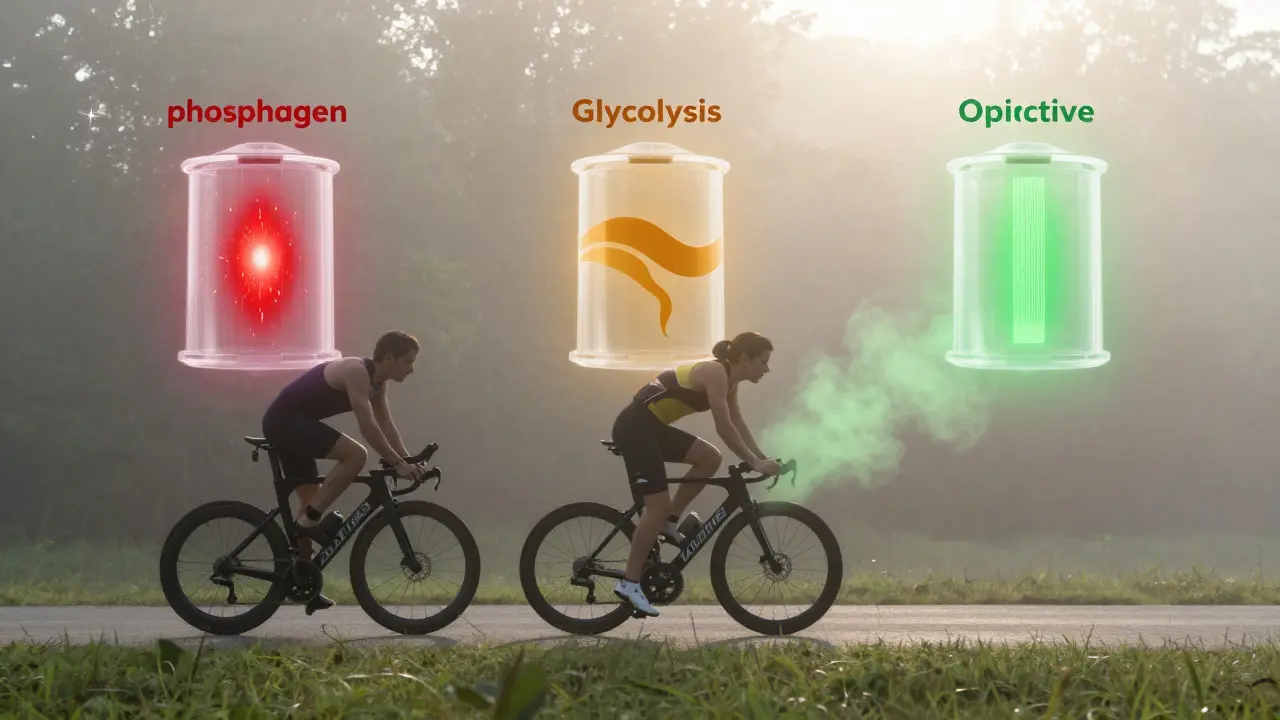
Your body doesn’t have one way to make ATP. It has three main systems, each with different speeds and capacities:
- The phosphagen system - gives you explosive power for 5-10 seconds. Think 100m sprints or a single heavy deadlift.
- Glycolysis - kicks in after 10 seconds and lasts up to 2 minutes. This is the system behind 400m races or high-intensity intervals.
- Oxidative phosphorylation - your slow-burn system. It fuels endurance activities like marathons, cycling, or long swims.
Each system uses different fuel sources. Phosphagen relies on stored creatine phosphate. Glycolysis burns glucose from your muscles and liver. Oxidative uses fat and carbs, but only if oxygen is available. The better you understand which system you’re using, the better you can train it.
Why Most Athletes Get It Wrong
Many athletes assume that if they’re not tired, they’re not working hard enough. That’s backwards. Fatigue isn’t just about muscle burn - it’s about energy system failure. If you’re doing long-distance runs every day, you’re training your oxidative system. But if you’re a sprinter, that’s not your bottleneck. Your phosphagen system is. Training like a marathoner won’t make you faster off the line - it might even slow you down by reducing your fast-twitch muscle fiber efficiency.
Same goes for recovery. A football player who takes 48 hours to recover between games isn’t just sore - their ATP and creatine phosphate stores are still depleted. Studies from the Journal of Strength and Conditioning Research show that athletes who prioritize phosphagen system recovery - through short, intense bursts and proper rest intervals - recover 30% faster than those who just rest passively.
Here’s the truth: you can’t improve performance by working harder. You improve it by working smarter - by aligning your training with the energy system you need to enhance.
Training Each Energy System
Let’s break it down by system, so you know exactly what to do:
1. Phosphagen System Training
Target: Max power, short bursts.
Best workouts:
- 10-second sprints with 60-90 seconds rest (repeat 6-10 times)
- Heavy squats or deadlifts (85-95% of 1RM), 3-5 reps, 3-5 minutes rest between sets
- Medicine ball slams or kettlebell swings for 8 seconds, 30 seconds rest, 8 rounds
Key rule: Rest longer than you think. If you’re still gasping after 30 seconds, you’re not training phosphagen - you’re training glycolysis.
2. Glycolytic System Training
Target: Power endurance, lactic tolerance.
Best workouts:
- 400m repeats at 90% effort, 2:30 rest (5-8 rounds)
- Tabata-style circuits (20 seconds on, 10 seconds off, 8 rounds)
- 30-second hill sprints with 1:30 rest (6-10 rounds)
Here’s what happens: your muscles flood with lactate. That’s not bad - it’s fuel. Training this system teaches your body to buffer lactate and convert it back to energy. Athletes who train glycolysis regularly can delay fatigue by up to 22% in 2-minute efforts, according to a 2023 study in Medicine & Science in Sports & Exercise.
3. Oxidative System Training
Target: Endurance, fat burning, recovery efficiency.
Best workouts:
- Zone 2 cardio: 60-75% max heart rate, 45-90 minutes, 3-5 times per week
- Long slow distance runs or bike rides
- Active recovery days: light swimming or walking
This isn’t just for marathoners. Even powerlifters benefit. Better oxidative capacity means faster ATP resynthesis between sets. A 2024 study on elite weightlifters showed that those who did 2-3 hours of Zone 2 cardio weekly recovered 18% faster between heavy sessions.

Recovery Isn’t Just Sleep - It’s Bioenergetic Restoration
Rest days aren’t lazy days. They’re recovery days. And recovery isn’t passive. It’s active restoration of your energy systems.
After a hard training session, your creatine phosphate levels drop by 50-70%. It takes 3-5 minutes to restore 90% of that - if you rest. If you do light movement, like walking or cycling at 40% intensity, you restore it 20% faster. That’s why active recovery works.
Nutrition matters too. Your body needs phosphocreatine, creatine, glucose, and oxygen to rebuild ATP. Eat enough carbs to refill glycogen. Get protein to repair muscle. Supplementing with creatine monohydrate (5g/day) has been shown in 12+ studies to increase phosphagen stores by 10-20%, directly boosting explosive power.
Real-World Examples
Consider a professional soccer player. They sprint 20-30 times per game, each lasting 3-5 seconds. Between sprints, they jog or walk. That’s not random - it’s bioenergetics in action. Their training mirrors this: short sprints, high rest, repeated. They don’t run 10 miles a day. They train their phosphagen and glycolytic systems to recover fast.
Or take a CrossFit athlete. Their WODs last 1-5 minutes. That’s glycolytic dominance. But if they train only high-intensity, they burn out. The best ones mix in Zone 2 cardio two days a week. Their recovery improves. Their lactic threshold rises. Their scores go up.
Even swimmers - often seen as pure endurance athletes - rely on phosphagen for starts and turns. Elite swimmers do 10x25m all-out sprints with 45-second rest. Not 10x200m. Because that’s what their race demands.
What You Should Do Tomorrow
Here’s a simple plan:
- Identify your sport’s dominant energy system.
- Track your last 3 workouts. Are they matching that system?
- Replace one session this week with a targeted bioenergetic workout.
- Rest longer between heavy efforts - at least 2 minutes for power, 1:30 for intensity.
- Add 1-2 Zone 2 cardio sessions per week - even if you’re a sprinter.
You don’t need more volume. You need better alignment. Train the system you use. Restore what you drain. That’s the real power of bioenergetics.
Myth vs. Reality
- Myth: More cardio = better performance.
Reality: Too much endurance training can reduce fast-twitch fiber recruitment and blunt power output. - Myth: Lactic acid causes fatigue.
Reality: Lactate is fuel. It’s hydrogen ions and pH drop that cause burn - and you can train your body to handle it. - Myth: Creatine is only for bodybuilders.
Reality: Every athlete who needs explosive power benefits - from tennis players to hockey goalies.
What is the main source of energy for muscle contraction?
The main source of energy for muscle contraction is ATP (adenosine triphosphate). No other molecule can directly power muscle fibers. Your body constantly breaks down and rebuilds ATP using three energy systems: phosphagen, glycolysis, and oxidative phosphorylation.
Can you train your bioenergetic systems like muscles?
Yes. Each energy system adapts with specific training. High-intensity, short-rest work improves phosphagen and glycolytic capacity. Low-intensity, long-duration work boosts oxidative efficiency. You can’t build endurance by doing sprints - and you can’t get faster by only jogging. Train the system you need to improve.
Does creatine supplementation help with bioenergetics?
Yes. Creatine monohydrate increases your muscle’s phosphocreatine stores by 10-20%. This gives you more rapid ATP regeneration during short, explosive efforts. It’s one of the most researched supplements - proven to improve sprint speed, jump height, and strength output in athletes across multiple sports.
Why do I feel fatigued during high-intensity intervals?
During intense efforts, your body relies on glycolysis, which produces hydrogen ions as a byproduct. These ions lower muscle pH, causing that burning sensation and reducing contraction efficiency. Training this system improves your body’s ability to buffer and clear these ions, delaying fatigue.
Is cardio bad for strength athletes?
No - if it’s done right. Low-intensity, steady-state cardio (Zone 2) improves recovery, circulation, and mitochondrial density, helping you bounce back faster between heavy lifts. Avoid long, high-intensity cardio sessions - they can interfere with strength gains. Two 30-45 minute Zone 2 sessions per week are ideal.
What’s Next?
Now that you understand how energy systems drive performance, you can stop guessing. Track your workouts. Match your training to your sport’s demands. Prioritize recovery as a science, not an afterthought. The difference between good and great athletes isn’t talent - it’s alignment. Your body already has the power. You just need to know how to unlock it.